
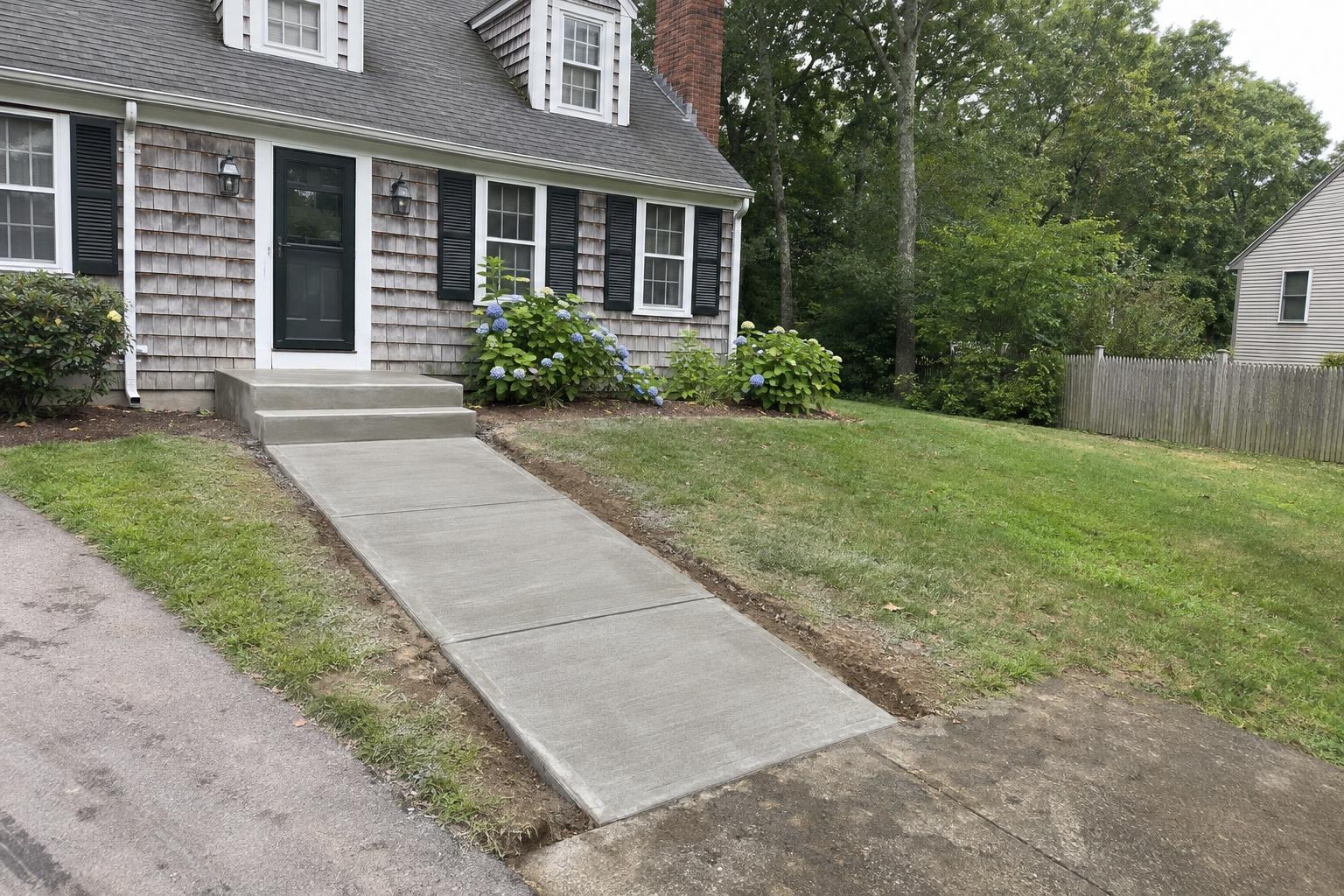
Concrete looks simple from the outside. Gray, flat, hard, done. What a homeowner can't see from a finished driveway or patio is the base underneath it, the mix that went into it, and whether the crew cut the joints in the right places at the right time. Those three things decide whether the slab lasts 30 years or starts cracking and heaving in its second winter. In Quincy, with the ground and weather we have here, getting them wrong is more common than you'd think.
The ground under Quincy doesn't forgive guesswork
A lot of Quincy sits on glacial till with pockets of clay, but a fair chunk of it sits on ledge. This is granite country, literally. The quarries in West Quincy and around Quarry Street supplied stone for buildings up and down the East Coast, and that bedrock is still close to the surface in plenty of yards. Hit it at 18 inches when you're digging footings for a stoop and your excavation plan changes fast. A contractor who's worked here before knows to probe or dig a test hole before quoting a price, not after signing the contract.
Closer to the water, in Houghs Neck, Adams Shore, and parts of Germantown, the water table runs high and the lots are low. A slab poured there without extra base and without attention to grading will hold water against the foundation or pond on the patio every time it rains hard. Ask any contractor bidding your job what they found when they looked at your yard. If the answer is vague, that's a sign they didn't actually look.
What should be under the slab and in it
Base prep is the part nobody sees once the job's done, which is exactly why some contractors skip it. A driveway or patio needs a compacted gravel base, typically 4 to 6 inches, more over soft spots or fill. Skimp here and the slab will settle unevenly within a year or two, no matter how good the concrete itself is.
For reinforcement, wire mesh gets used a lot because it's cheap, but it tends to sag to the bottom of the pour if nobody chairs it up, where it does almost nothing. Rebar, tied and supported on chairs, holds its position and carries load better, especially for a driveway that'll see a car or a plow blade. Ask which one is going in and how it'll be supported during the pour.
Then there's the mix itself. For anywhere in Massachusetts that sees real winters, the concrete needs to be air-entrained, meaning tiny air bubbles are mixed in on purpose, usually 5 to 7 percent air content. Quincy gets somewhere around 40 to 60 freeze-thaw cycles a typical winter, plus road salt tracked onto driveways from December through March. Concrete without the right air content will flake and scale at the surface within a couple of seasons. A driveway mix here should run 3,500 to 4,000 PSI. If a contractor can't tell you the PSI or the air content off the top of their head, they're probably ordering whatever the ready-mix plant sends by default.
Control joints matter more than people think. They're the shallow cuts that tell the slab where to crack, instead of letting it pick its own spot. They should go in within 24 to 48 hours of the pour, spaced roughly 2 to 3 feet apart for every inch of slab thickness, so a standard 4-inch walkway or patio gets a joint every 8 to 10 feet. Skip this step or cut late and you'll get a random crack running straight across your new patio by next spring.
Curing time is the other thing people underestimate. Concrete can usually take foot traffic after about 24 to 48 hours, but it needs roughly 7 days before a car drives on it, and closer to 28 days to hit full design strength. A contractor who tells you to park on a new driveway the next day either doesn't know better or doesn't care.
Permits and inspections in Quincy
Most structural concrete work, foundations, retaining walls over a certain height, additions with a slab, needs a building permit through the City of Quincy's Inspectional Services Department. A driveway apron that crosses the sidewalk or ties into the street may also need a separate permit from the Department of Public Works, since that strip technically belongs to the city. If your lot is close to a property line, a setback check is worth doing before anyone breaks ground, especially on the older, tighter lots common in neighborhoods like Quincy Point and Wollaston where houses were built close together in the early 1900s. Newer subdivisions tend to have more breathing room, but some of those come with a condo association or HOA that has its own rules about exterior work, so check your documents before you get a quote.
A contractor who routinely pulls permits in Quincy will know this without being asked. One who suggests skipping the permit to save time or money is handing you the liability instead of taking it on themselves.
Red flags that mean you walk away
- A bid that's noticeably lower than everyone else's. The difference is almost always in the base depth, the slab thickness, or the mix quality, not in the company's generosity.
- No written quote specifying slab thickness, PSI, and reinforcement type. A verbal promise means nothing once the concrete truck leaves.
- Cash only, no contract, no mention of a permit.
- Willingness to pour in freezing temperatures without blankets or a heated enclosure. Concrete poured below about 40°F without protection can freeze before it cures and never reach proper strength.
- No answer when you ask who's actually finishing the slab. On some jobs the sales rep who quotes you never touches a trowel.
What a solid quote actually includes
A good quote should spell out the base depth, the slab thickness, the PSI, whether it's rebar or mesh, the joint layout, and a rough timeline including cure time before you can use the space. It should mention who's pulling the permit. If drainage is a concern on your lot, it should say what's being done about it, whether that's a slope built into the pour or a drain tied into it.
None of this is complicated once you know what to ask. It's the difference between a slab that handles 20 Quincy winters and one that's cracked and patched by year three. We do this kind of work across Quincy and the surrounding towns, and Foundation Concrete Co is happy to walk through what your yard specifically needs before you commit to anything.